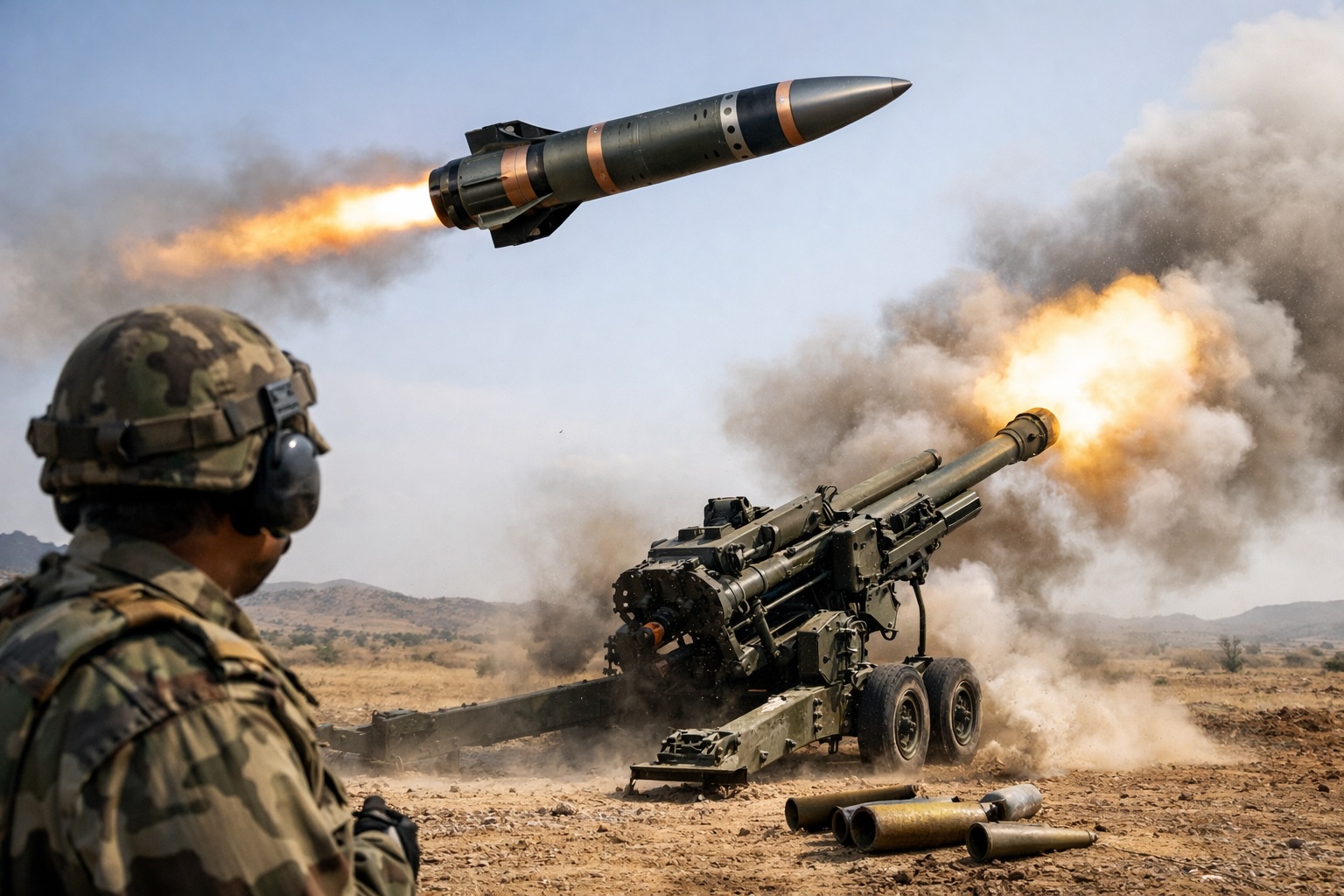
Chennai: The Indian Institute of Technology Madras (IIT-Madras) has launched a pioneering research initiative aimed at dramatically increasing the strike range of the Indian Army’s multiple-barrel rocket launcher systems through advanced ramjet propulsion.
Scientists from the institute’s propulsion research division are working on integrating compact ramjet engines into existing rocket artillery platforms, including the Soviet-origin BM-21 Grad and India’s indigenous Pinaka system. If successful, the upgrade could potentially double the effective range of these battlefield weapons without requiring entirely new launch platforms.
The BM-21 Grad, which remains in widespread service with the Indian Army, currently has an operational range between 20 and 40 kilometres, depending on the ammunition variant. The proposed ramjet-assisted rockets are expected to push this reach beyond 80 kilometres. Unlike conventional solid-fuel rockets, ramjets sustain thrust using high-speed incoming air, offering better efficiency and sustained propulsion at supersonic speeds.
Pinaka, developed by the Defence Research and Development Organisation (DRDO), already represents a major leap in India’s indigenous artillery capability. While existing variants achieve ranges from 38 to nearly 90 kilometres, ramjet-enabled versions under study could exceed 150 kilometres, significantly enhancing deep-strike options for the Army.
Initial ground testing of the ramjet-based Grad rockets is scheduled to begin by March 2026. The testing phase will include simulations, wind-tunnel studies and sub-scale trials, followed by full-scale rocket firings. Comprehensive operational validation is currently planned for completion by 2028.
Ramjet propulsion is particularly effective at high Mach numbers, as airflow compression occurs naturally without moving mechanical components. For rocket artillery, this translates into longer flight endurance, improved payload-to-range ratios and the possibility of integrating advanced guidance kits for higher accuracy.

Engine ignition during launch, thermal protection, and compatibility with existing launcher systems remain key technical challenges. IIT-Madras researchers are addressing these issues through modular engine designs that can be adapted to standard rocket calibres, including the 122mm Grad format.
The project builds on India’s expanding expertise in air-breathing propulsion technologies, demonstrated by programmes such as the Hypersonic Technology Demonstrator Vehicle (HSTDV). Collaboration with DRDO laboratories and private defence firms is expected to accelerate development and transition to production.
From a strategic perspective, extended-range rocket artillery would enhance the Army’s stand-off capabilities, especially in high-altitude and border regions such as Ladakh and the Northeast. Longer-range Pinaka variants would allow forces to engage deeper targets while operating well outside enemy counter-fire envelopes.
Funding for the initiative is likely to come through the Army Technology Board and DRDO’s extra-mural research schemes. Once validated, industrial partners could scale production, offering the Army a cost-effective modernisation pathway while preserving compatibility with existing logistics and launcher infrastructure.
If development milestones are met, user trials could begin by 2028, aligning with India’s broader artillery modernisation plans. The initiative highlights the growing role of academic institutions in strengthening India’s defence innovation ecosystem and advancing the goals of Atmanirbhar Bharat.